


All suffering is loss, but God leaves nothing unused in His plans. We help women see His redemptive thread throughout their circumstances and then look for opportunities to join with God in His transforming work.
Shepherding, Safety, and Spiritual Care Questionnaire
Spiritual, Emotional, and Psychological Abuse Questionnaire


Dr. Ann Maree Goudzwaard
Founder and Executive Director of Help[H]er.

Season 7 Episode 11 - Expert Contributor Rachael Clinton Chen
To Heal or Harm Steven Tracy
Holy Hurt, Hillary McBride
Something’s Not Right, Wade Mullen
Escaping the Maze of Spiritual Abuse, Lisa Oakley
Breaking the Silence on Spiritual Abuse, Lisa Oakley
Downsizing, Michelle Van Loon
When Narcissim Comes to Church, Chuck DeGroat
Healing What’s Within, Chuck DeGroat
The Subtle Power of Spiritual Abuse, Dave Johnson, Jeff Van Vonderen
Institutional Betrayal Questionnaire
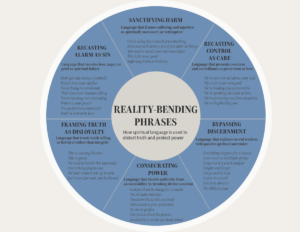
Season 7 Episode 10 - Summer Book Review: To Heal or To Harm
To Heal or Harm Steven Tracy
Holy Hurt, Hillary McBride
Something’s Not Right, Wade Mullen
Escaping the Maze of Spiritual Abuse, Lisa Oakley
Breaking the Silence on Spiritual Abuse, Lisa Oakley
Downsizing, Michelle Van Loon
When Narcissim Comes to Church, Chuck DeGroat
Healing What’s Within, Chuck DeGroat
The Subtle Power of Spiritual Abuse, Dave Johnson, Jeff Van Vonderen
Institutional Betrayal Questionnaire
Season 7 Episode 9 - Expert Contributor Rachael Clinton Chen
Resources for Further Exploration
The Allender Center
Rachael serves as Lead Instructor at The Allender Center, where she teaches at the intersection of trauma, abuse, story, embodiment, healing, and spiritual formation.
Story Workshop for Spiritual Abuse and Healing
Led by Rachael through The Allender Center, this workshop creates space to explore the impact of spiritual abuse and the process of healing through story, embodiment, and faith.
Tabitha Westbrook — Spiritual Abuse
Rachael references therapist, educator, and speaker Tabitha Westbrook’s definition of spiritual abuse: the weaponization of a person’s good and right devotion to God against them.
Reclamation Collective
Rachael draws from its work in describing spiritual abuse as the use of power within a religious or spiritual context to control or manipulate another person’s body, thoughts, emotions, actions, choices, freedom, or autonomy.
Religious Trauma Institute
A resource for understanding religious trauma and the ways harmful religious experiences can affect identity, relationships, the body, and a person’s sense of safety and belonging.
Dr. Alison Cook
Rachael references Dr. Cook’s work in describing the distinctive impact of spiritual trauma: trauma can cause us to question our worth, while spiritual trauma can add the fear that God questions our worth as well.
Grooming: “Attunement Without Honor”
Rachael describes grooming as an abuser’s ability to recognize and respond to another person’s legitimate needs for care, belonging, affirmation, or connection—but without honoring that person’s dignity. The care becomes a means of gaining trust and access for exploitation.
Gaslighting, Fear, Shame & Scapegoating
Rachael identifies these as common tools of spiritual abuse. Fear and shame can reinforce compliance and loyalty, while gaslighting can cause a person to question their perception of reality and even reinterpret appropriate resistance to harm as pride, sin, unforgiveness, or spiritual failure.
The Body as a Truth Teller
Rachael emphasizes the importance of embodiment in recognizing and healing from spiritual abuse. When people have been taught to distrust or override their bodies, anxiety, fear, panic, and other physical responses may be treated only as spiritual failures rather than information worthy of attention.
Repair & Rebuilding Trust
In considering whether repair is possible after spiritual abuse, Rachael offers several important questions: How is power being shared? Are policies and systems changing? Is there transparency? Are people taking accountability and changing their behavior in ways that can begin to rebuild trust?
Need Support?
If this conversation stirred something for you, you do not have to navigate it alone.
Help[H]er provides trauma-specialized advocacy, education, and navigation for women in crisis in the church, guiding them toward safety, agency, and restored dignity.
Learn more or connect with Help[H]er at HelpHer.help.
About Safe to Hope
Safe to Hope creates space for women to tell their stories of suffering and loss with care, dignity, and honesty. Nothing in our storyteller conversations is intended to pressure forgiveness, reconciliation, or closure. Our aim is to listen with care and honor the dignity of each woman’s experience.
Season 7 Episode 8 - Storyteller
Resources Related to This Story
Leigh’s story explores the subtle dehumanization of women within church systems, including what happens when women carry significant responsibility without corresponding voice, when decisions about women are made without women, and when concerns about biblical authority obscure important questions about power.
Three Female Ghosts That Haunt the Church — Jen Wilkin
Leigh references Wilkin’s descriptions of three stereotypes through which women can be viewed in the church: the usurper, the temptress, and the child.
The Inner Ring — C. S. Lewis
Referenced in connection with Leigh’s description of women sitting around the perimeter of meetings while male leaders occupied the table. Lewis explores the desire to belong to an “inner ring” and how that desire can contribute to exclusion.
The Allender Center
Leigh has received Level Three trauma training through The Allender Center. Its work explores trauma, abuse, story, embodiment, and healing.
Power, Authority, and Responsibility
Leigh distinguishes between conversations about authority and conversations about power, asking how churches can know whether power is being used lovingly or harmfully if they are unwilling to examine how it functions. She also describes the harm that can occur when women carry significant responsibility without corresponding voice or influence.
Grief, the Body, and Institutional Harm
Leigh describes realizing that her body was responding to the church conflict before her mind could fully understand what was happening. Leaving staff brought grief not only over a job, but over calling, relationships, reputation, and a church in which she had invested decades of her life.
Repentance, Repair, and Rebuilding Trust
Leigh’s story also offers a picture of what meaningful repair can begin to look like. Leaders acknowledged specific ways they had been passive or complicit, listened to her distrust without defensiveness, and followed confession with changes in practice that gave women greater voice and access to previously closed spaces.
Need Support?
If this conversation stirred something for you, you do not have to navigate it alone.
Help[H]er provides trauma-specialized advocacy, education, and navigation for women in crisis in the church, guiding them toward safety, agency, and restored dignity.
Learn more or connect with Help[H]er at HelpHer.help.
About Safe to Hope
Safe to Hope creates space for women to tell their stories of suffering and loss with care, dignity, and honesty. Nothing in our storyteller conversations is intended to pressure forgiveness, reconciliation, or closure. Our aim is to listen with care and honor the dignity of each woman’s experience.

